This is a quick transfer of a massive twitter thread I posted in June, 2023. Since Txitter is more difficult to read these days without an account, and even less worth it than ever to create an account.. I will try to transfer some threads back to here.
This is basically just an archive of nice figures related to physiological effects of cadence.
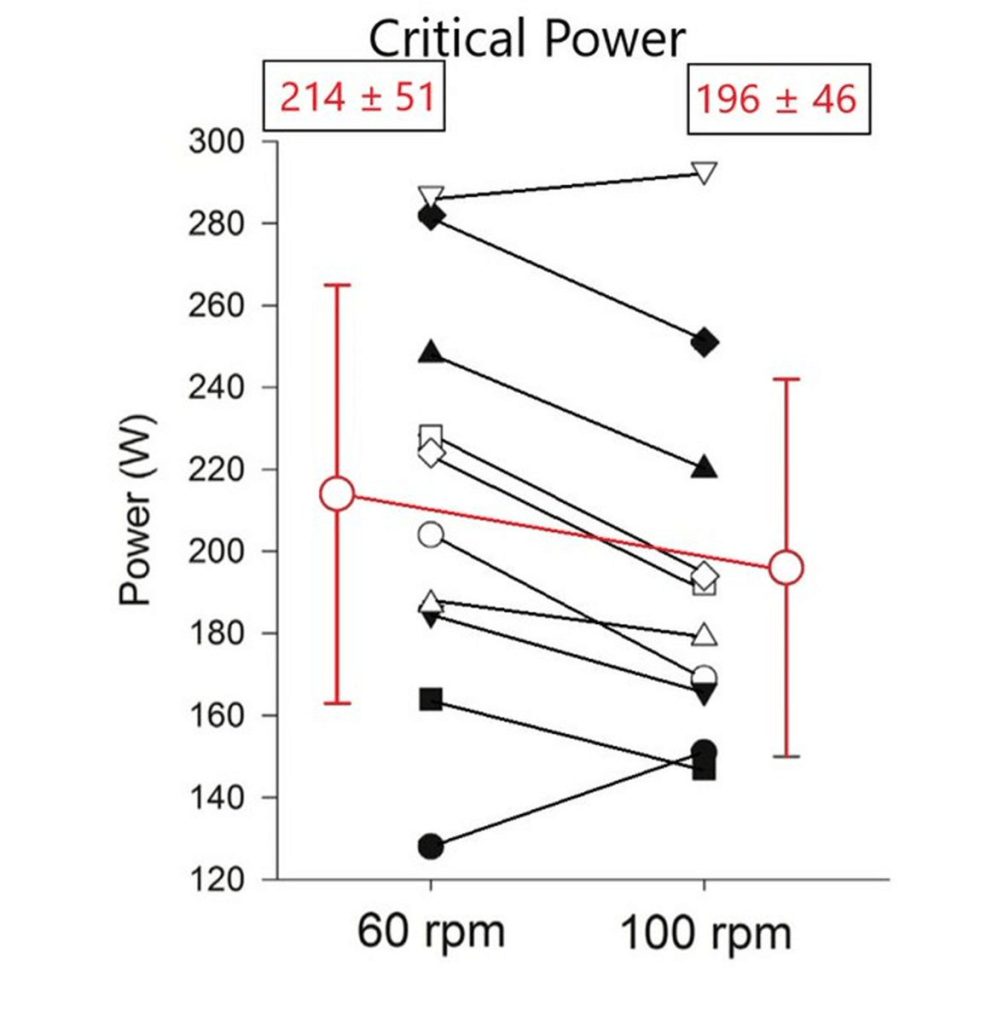
Critical Power (CP) is lower at a higher cadence of 100 rpm vs 60 rpm, and costs more oxygen uptake (V̇O₂).
But cyclists often prefer cadences in the range 80-100 rpm. 🤔
Does training at lower or higher cadence offer greater improvements to Critical Power (CP) & V̇O2max?
Or as Robert Chung suggests, is cadence a red herring when it comes to training optimisation?
Regardless, I find the influence of cadence on physiology fascinating! Here’s some of what I’m learning.🚴
CP is indeed greater at around 60 rpm and lower around 90-100 rpm.
For most maximal tests, power output and/or time to exhaustion (TTE) will be lower at higher cadence. Maximal sprint tests at higher power and shorter duration appear to be less affected than longer maximal efforts closer to CP.
This results in a decrease in the power asymptote of a critical power test. W’ (work capacity above CP) appears to be unaffected.

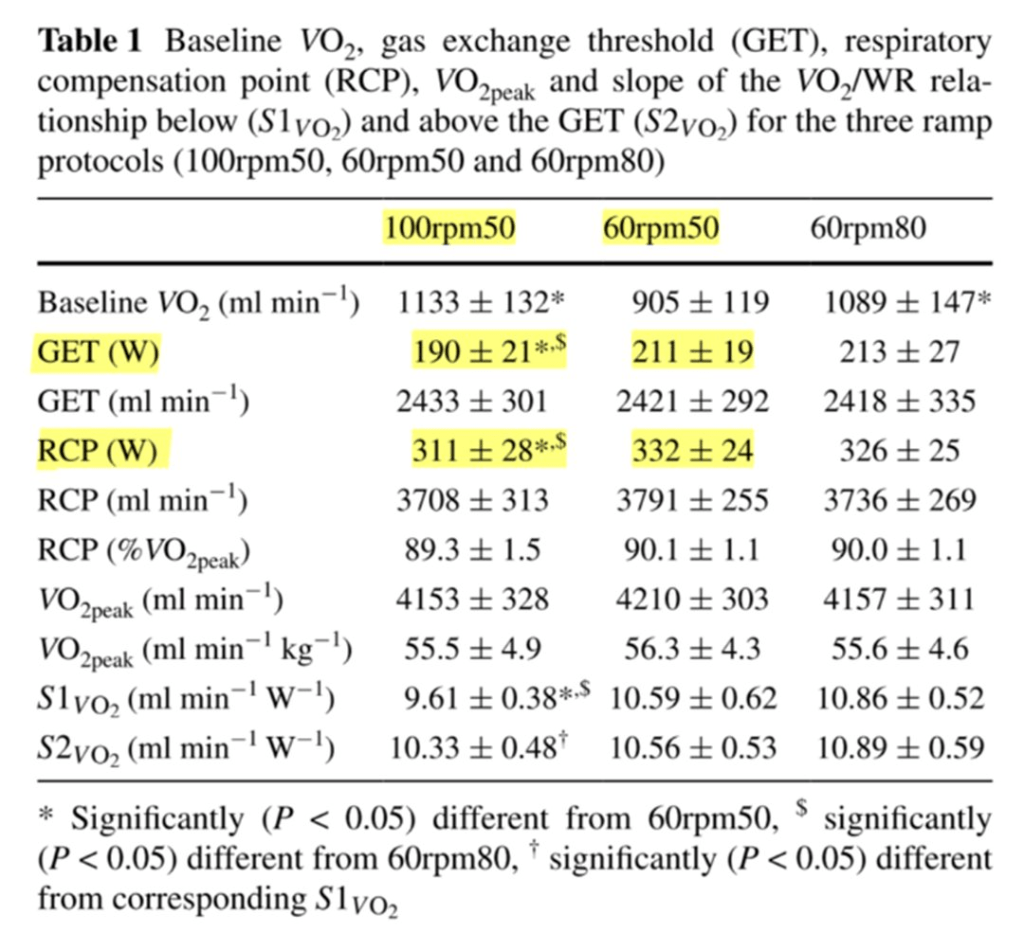
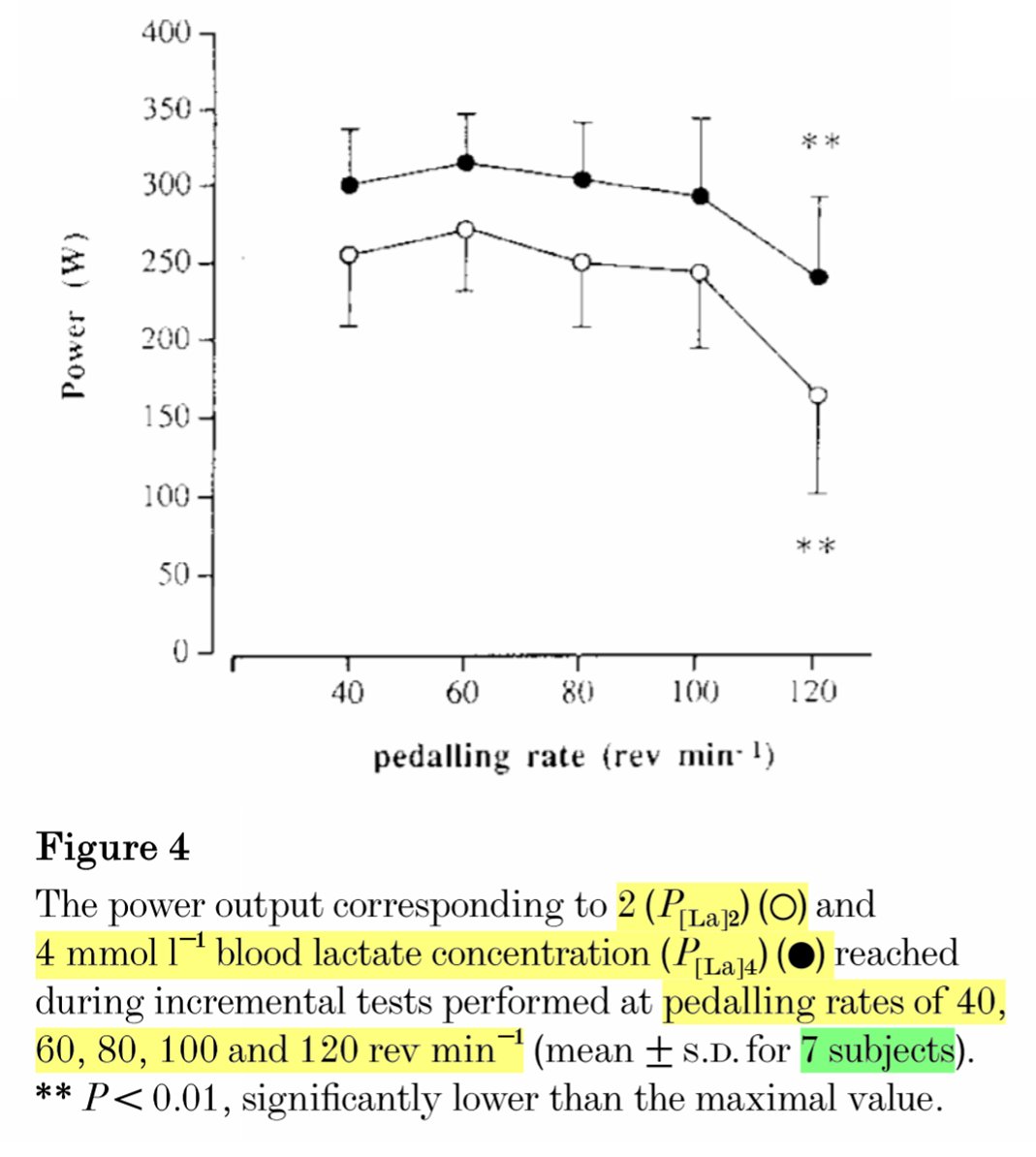
In an incremental ramp test, V̇O2 is the same at the metabolic thresholds (VT1/GET & VT2/RCP) but the power output at those thresholds are lower when cadence is higher.
At V̇O2peak & Wpeak at the end of the ramp test, this power difference disappears. Workloads closer to max are less affected by cadence (why below).

Blood lactate ([BLa]) 🩸 is higher at any workload with higher cadence.
Lactate thresholds (LTs) appear to occur at greater [BLa] and the same or reduced power.
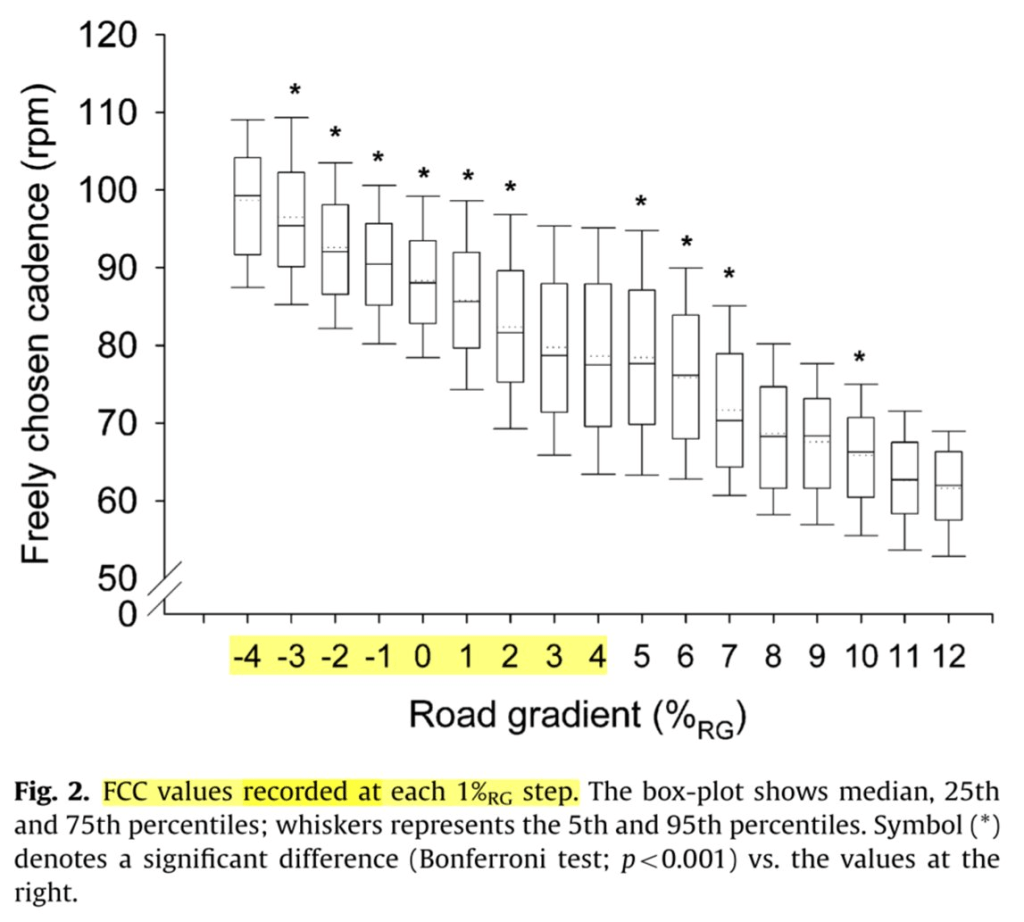
Losses are greater above freely chosen cadence (FCC) / naturally preferred cadence (~90-100 rpm).


By the way, I’ve tried to synthesize piles of literature to reach a current best interpretation. 📚🤓 📖
Every statement is supported by at least one key reference, but consider me 75% confident at best
This one goes deep! TLDR at the end 📜
Save this 🧵 to explore the figures references later!
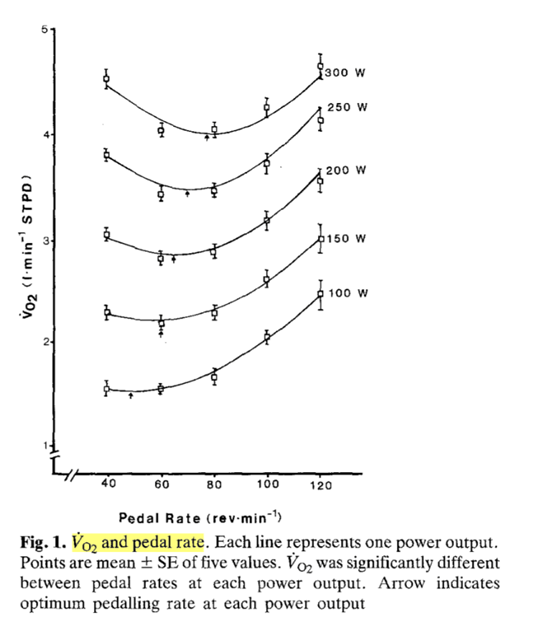
So lower cadence costs less V̇O2 for the same power, meaning improved submaximal cycling economy.
And power at thresholds is greater.
Then why is freely chosen cadence (FCC) typically closer to 80-100 rpm than to 60 rpm?
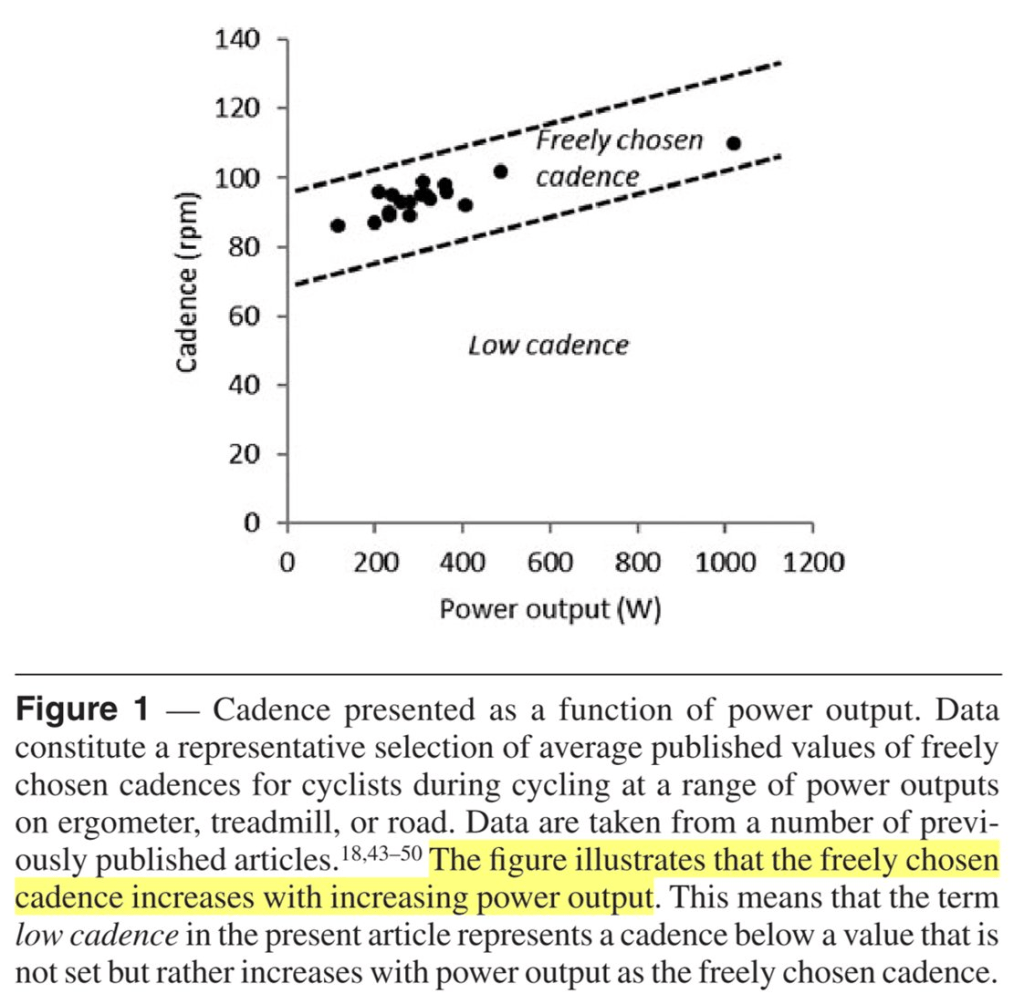
A major factor is that energetically optimal cadence and FCC increase linearly with increasing workload.
Higher workload ⇒ higher mechanical efficiency ⇒ higher optimal cadence.
FCC is ≤60 rpm at 100 W.
FCC is ~100 rpm at 400 W.
And even higher for sprints.

This explains why power at submaximal thresholds is lower at higher cadence, while Wpeak is no different at V̇O2max.
Also at least partially why professionals appear more efficient at higher cadences: because at the same relative intensity they are working at much higher workloads, therefore will be more efficient at higher cadence related to the higher workload alone.
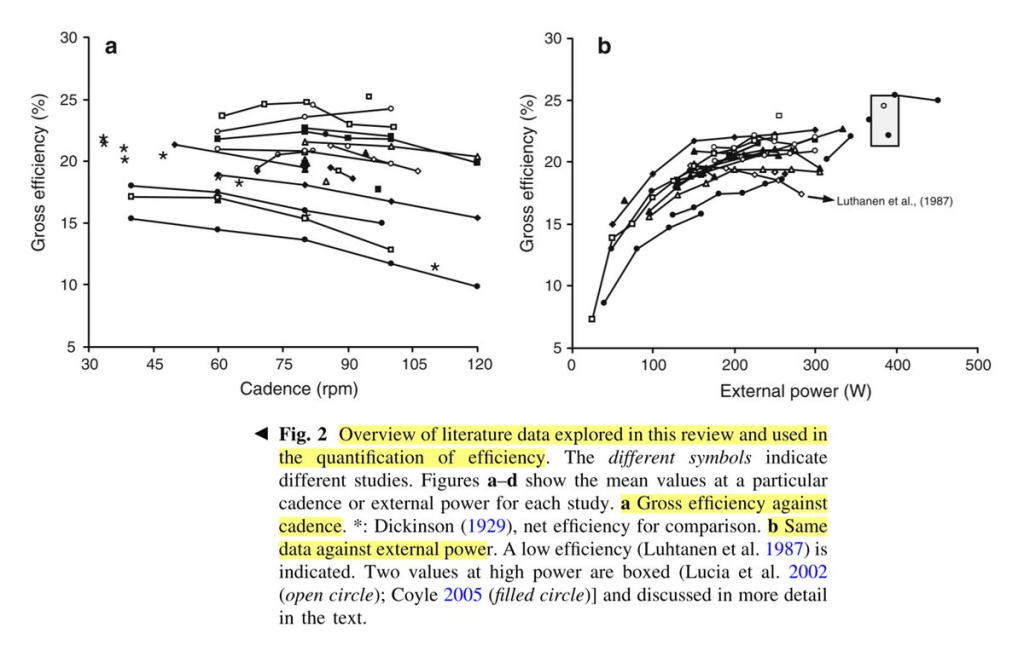
Maybe the biggest factor behind cadence is optimising for metabolic work and neuromuscular fatigue with greater torque required at lower cadence.
It is thought that perceived effort (RPE) is minimised around the optimal balance between metabolic efficiency and joint torque. Freely chosen cadence minimises both. Our brain is good at optimising these kinds of trade-offs.

Also consider prolonged duration:
After 2 hours cycling, FCC is reduced closer to the energetically optimal cadence (e.g. 87 rpm is reduced to 69 rpm in the figure below).
Possibly related to fatigue of faster (type II) fibres and preservation of slower (I) fibres.

Why is cycling efficiency lower at higher cadence anyway?
It has to do with fibre contractile properties at a micro scale and whole-body working muscle mass at a macro scale.
Let’s get into fibre contractions, blood flow, & muscle recruitment!💪🩸

Leg blood flow (BF) increases linearly in proportion to increasing workload.
Energetic demand for oxygen drives higher BF to supply O2 to match the required muscle metabolic rate (mV̇O2).
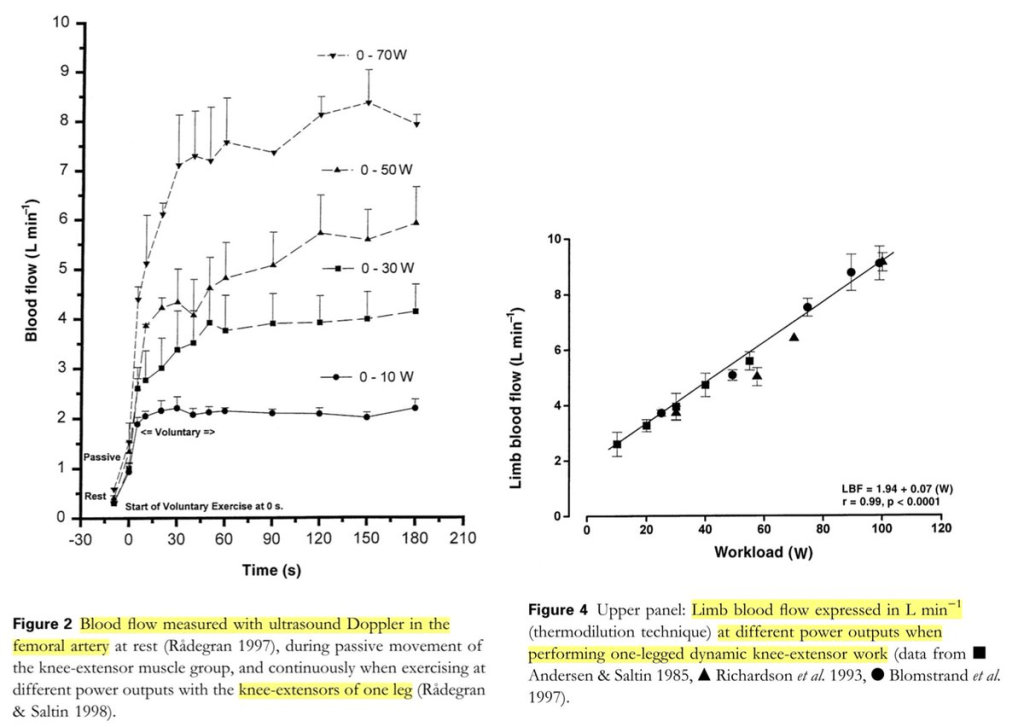
Similarly, Leg BF is higher at higher cadence, while relative O2 extraction (a-vO2 diff) remains constant.
Higher leg BF is proportional to higher leg mV̇O2 (demand drives supply)
Meaning higher cadence does not deliver ‘extra’ BF & O2: BF is higher because leg V̇O2 is greater for the same external power, meaning the same power output costs more energy.

NIRS (muscle oxygenation) can be used to calculate mV̇O2 in individual muscles.
These measurements suggest that quadricep (vastus lateralis, VL) mV̇O2 is greater when cadence is above FCC at submaximal workloads (75% LT2 4mmol, in the heavy domain).
The same power output costs more energy & requires more oxygen delivery and BF.

NIRS shows conflicting observations for whether VL has higher or lower absolute oxygen saturation values at different cadences. Generally suggesting that O2 delivery is well matched to mV̇O2 (delivery is matched to supply) in the VL.
But there is a lot of variability between muscle sites, at different intensities, and of course in different individual athletes.

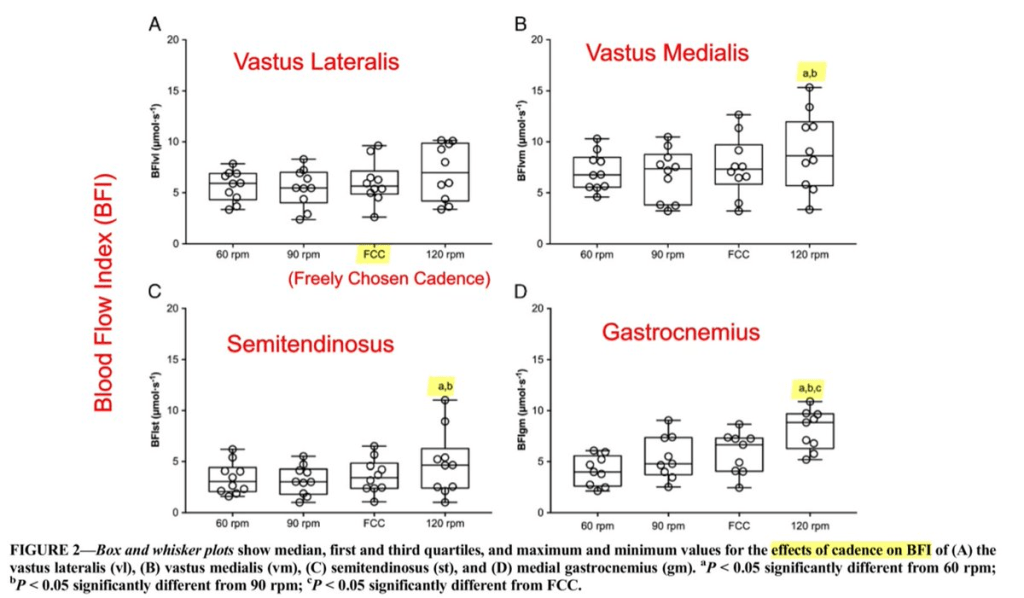
Using NIRS with a dye tracer suggests that BF is increased with higher cadence above FCC in multiple locomotor and accessory muscles. This supports the matching of elevated O2 delivery to O2 extraction (mV̇O2).
Even more so in the ‘accessory’ muscles than in the primary locomotor VL. Intramuscular tension during contractions in the VL is important to consider…
The trick is, muscle BF is drastically decreased transiently during every single pedal contraction from intramuscular tension. Muscle contraction squeezes the capillaries and briefly stops blood flow. BF then increases even more drastically during relaxation between pedal strokes.
At lower cadence there are longer relaxation periods between contractions, meaning that net BF is increased per contraction.
But still net BF over time is lower at lower cadence because of the lower O2 demand. Demand drives supply.

BF & O2 delivery has an upper limit, above which energetic costs cannot be met wholly
oxidatively. This limit occurs around Critical Force in isolated muscle, analogous to Critical Power. BF increases to match mV̇O2 at higher cadence, until reaching this maximum limit, meaning that the power output (CP) at this maximal metabolic rate is reduced.

Again, this suggests that higher BF with higher cadence cannot deliver ‘extra’ O2 to the working muscle through muscle pump action.
O2 delivery is increased because the muscle metabolic rate (mV̇O2) extracts more O2 to produce the same external workload. CP is lower at the same metabolic rate.
Where in the muscle is the demand for O2 elevated?

By the way, if you are interested in learning more about muscle oxygenation in sport science, take a look at my previous twitter-thread reference list with key findings & applications of NIRS 💪🔦🧐
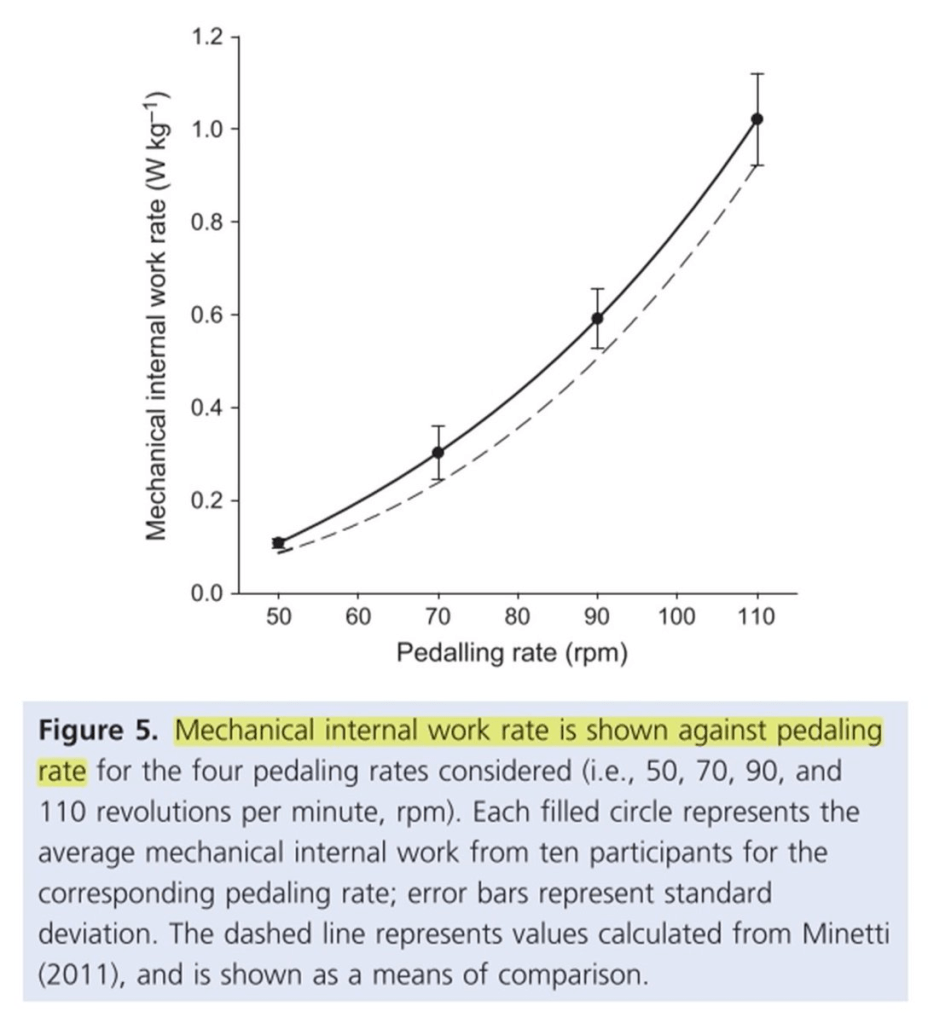
At the muscle fibre micro-level, contraction energetic cost is proportional to the speed & acceleration of the muscle contraction (e.g. change in velocity and direction from shortening to lengthening).
Higher cadence ⇒ faster contraction speed & more accelerations (more direction changes) per unit time ⇒ higher energy cost.
Higher contraction speed may also shift recruitment toward faster (type II) fibres.

Fibre-level increases in energy costs include ⬆️ion flux, ⬆️inertia, & ⬆️viscoelastic losses. Summed across multiple muscles this results in net total increased internal metabolic work for the same external power output.
This connects us from the micro to the macro!
Why do secondary (non-primary locomotor) muscles see higher BF at higher cadence, moreso than for the VL? (from a few figures above).
Because they’re working harder to stabilise & allow the locomotor muscles (VL) to produce the required external force! 🦵🦿 The locomotor muscles need a stable base of support to push against to generate force on the pedals.

More muscles working harder to produce the same power at higher cadence will of course require more energy.
⬆️muscle mass recruited ⇒ ⬆️muscle V̇O2 ⇒⬆️systemic V̇O2 ⇒⬆️cardiac output (CO), ⬆️HR, & ⬆️stroke volume (SV)
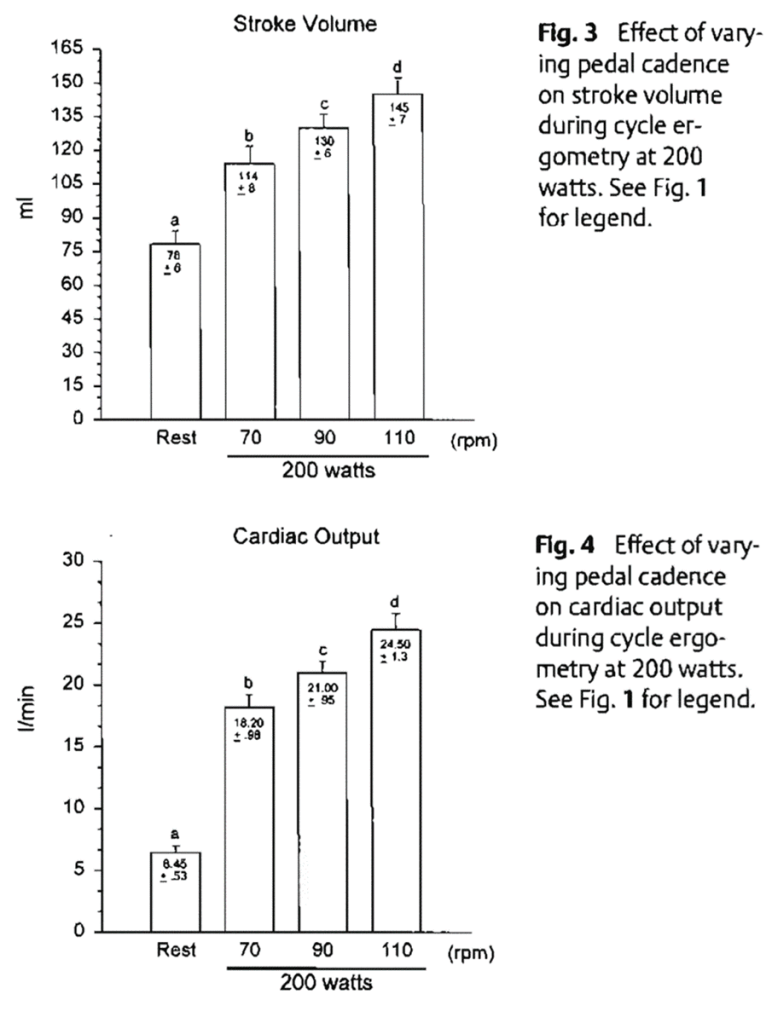
If we get ⬆️V̇O2 ⬆️SV & ⬆️CO with high-cadence training, will that let us spend more time near V̇O2max and gain better adaptations? Sounds promising!
However, improvements to V̇O2max are typically no different training at higher or lower cadences. Here is some of the science on that.

Training at higher cadence tends to increase freely chosen cadence (FCC) and might produce greater efficiency at that higher FCC, at submaximal workloads.
However TT performance appears to improve marginally more after low-cadence training, not high-cadence, if at all.

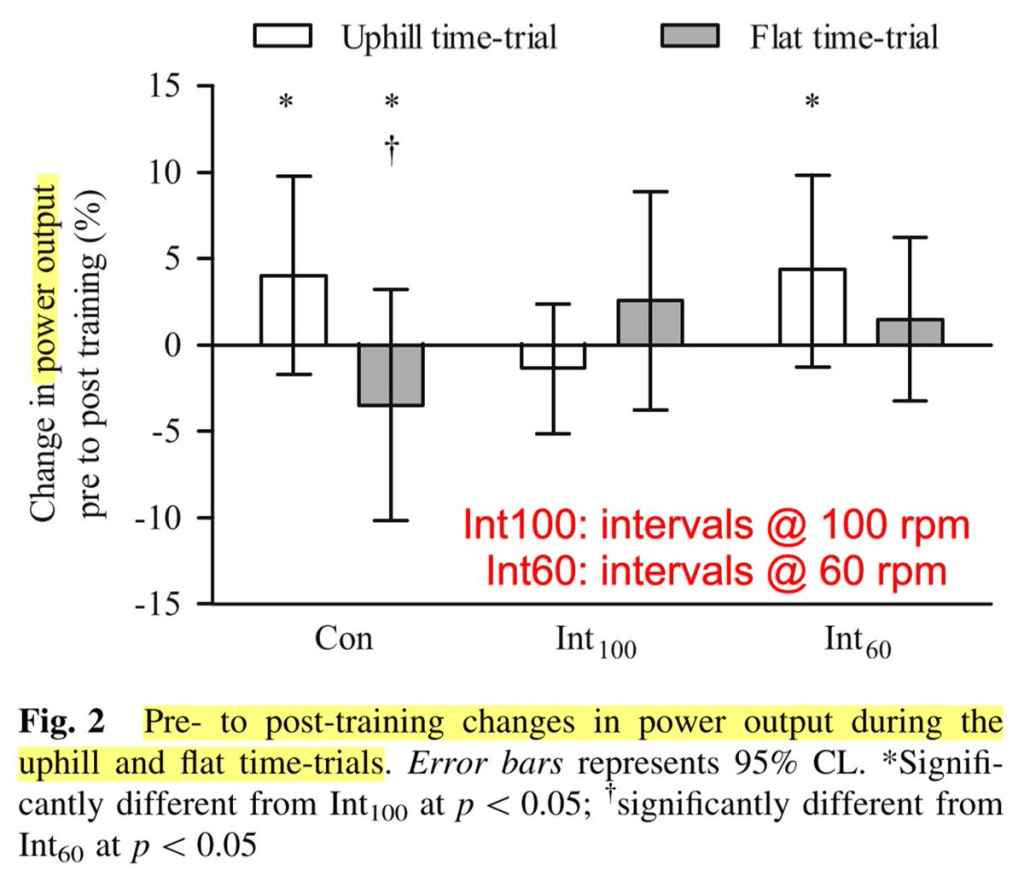
Training & familiarisation to difference cadences may play a role in terrain preference (hills vs flat), beyond the expected anthropometric (body size & mass) differences.
If you train exclusively at lower cadence climbing in the mountains, you might find it difficult to produce the same power in a flat TT. And vice-versa.

Preferred cadence on a fixed trainer tends to be higher than FCC outside on the road.
This is probably related to differences in crank inertia & altered muscle recruitment patterns.
If we expect power & efficiency to be different indoor vs outdoor (and we should), should we also change our training zones? 🧐

Fitter cyclists tend to produce relatively greater power from hip extension (glutes) than less fit cyclists.
The hypothesis is that the same metabolic load is distributed across greater muscle mass.
Glutes also tend to contribute relatively more power at lower cadence.

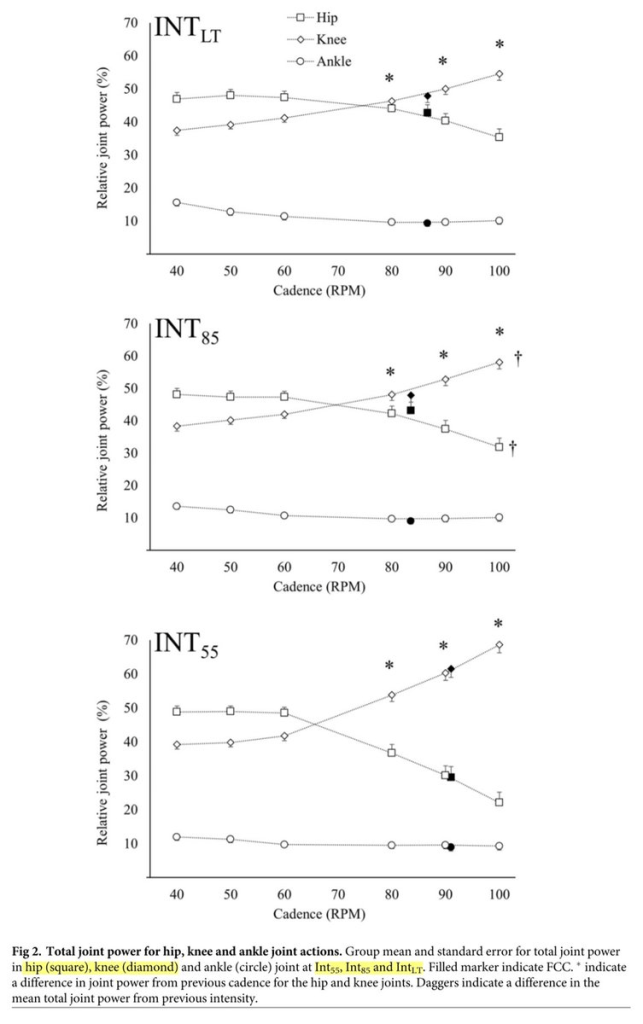
Is it possible that low-cadence training will improve the adaptive stimulus with increased glute recruitment, thus the ability to distribute the metabolic load over more muscle mass, and thus improve overall fitness?
AND/OR
Will high-cadence training improve neuro-coordination to allow more glute/hip extension recruitment at higher cadences?
Maybe both?

TLDR, Story Recap, and Interpretations for Application
So… Is there a “best” cadence for training and racing?
I think the answer is…
Yes.
All of them.
If we can improve our functional cadence range, we may improve our power output or at
least our familiarisation across a wider variety of conditions & demands (60% confidence on this opinion).
Should we be focused on optimising our cadence during every training session, forever?
No.
Our brains are pretty good at self-optimising toward the task-demand optimum.
Maybe just throw in some novel cadences during otherwise monotonous training sessions.
I think of cadence training as just “something to do” – something to focus on during otherwise bog-standard training sessions. Why not, if we’re not doing anything else?🤷♂
TLDR Story recap! 📜
Higher cadence is less efficient at the muscle fibre micro-scale because faster contractions cost more energy🚴
And at the whole body macro-scale because more muscles are engaged for stabilisation to produce same power🦵
Higher cadence creates greater demand for energy, meaning greater oxygen uptake (mV̇O2), which drives higher supply of O2 and blood flow, which then reach maximum at a lower external power output, meaning CP is lower🫀
Preferred cadence is greater than energetically optimal cadence because the sensation of effort is optimised for the competing demands between minimising intramuscular tension (favouring higher cadence) and metabolic costs (favouring lower cadence)⚖️
Preferred cadence is modifiable and efficiency can improve with training, but evidence for any effect of specific high- or low-cadence training on performance outcomes is equivocal.
There is so much more to this story, like crank length, inertia, fixed trainer vs flat road vs
uphill, pedal dynamics, fibre typology…
But this 🧵 is already stupid long 😅
What are some other missing pieces?
What questions remain?
How do you use cadence training?
fin

 Spare Cycles
I TLDR’d it! All I know is that Seymour forces my SST training at 60 RPM 🙂
LikeLike
Interesting read!
LikeLike
Very interesting read!
LikeLike
Big Blindspot is CRANK LENGTH. It is absurd that we have essentially 1 size fits all (10mm diff is insignificant).
Im a couple of months into riding 150mm cranks (diy chop). I now hate spinning giant circles. I’m 173cm, 64kg, 45yo.
Once I realised I need to put seat back as much as up, my power is equal. Set a PB on a 8% climb over 10mins this week.
Beyond this the bike fit, ergonomic and aero benefits are worth it, even if I lost some power. I can now comfortably use the drops, as hip angle is opened up.
Also, post ride muscle fatigue feels much much less
I’ve researched this topic a lot. Ultimately, as short cranks are not mass produced, there is limited ‘sample size’ of data. Unfortunately, access to short cranks is expensive.
I’ll add that short cranks in all cycling disciplines is a huge benefit. Riding my MTB is also much improved. Having feet close together helps manouver.
I’d like to think this is the next big adjustment coming to the industry. It should lead to bike geometry changes, based on proportional crank length fit.
Oh, and crank length rarely, if ever gets mentioned on the topic of cycling cadence!! Shorter = higher. That said, do taller riders have a ‘naturally’ higher cadence, I bet they do!
LikeLike
Thanks, absolutely agree. And I think we’re seeing that trend well underway over the last few years. As I said at the bottom of the article, I had to leave that out as a slightly tangential topic that deserves it’s own deep dive at some point.
The research on crank length is quite interesting. Crank length per se doesn’t affect much when everything else is controlled, but in the real-world it drives so many downstream small changes that seem to add up to large, noticeable effects on comfort and perception of effort (although not necessarily to peak performance). I’m a big fan of using appropriate crank length for our biomechanics and our task demands.
LikeLike
Cheers Jem.
It the holistic picture of bike fit, everything is adjustable to body size proportions, except crank length.
Shorter folk are been dudded more by this.
I just took my roadie for its first spin with 150mm. I can literally live in the drops, and I’ve always hated them.
Aero gains also more notable on the roadie. More PBs found and I wasn’t smashing it.
I truly think bike fit (and even size) ought to start with crank length…
LikeLike
hi. Have you a view of actual energy expended just moving the leg “masses” around the crank. I would assume that a lower cadence would mean less energy expenditure, so perhaps part the equation?
LikeLike
Hi, yes that’s exactly right. The metabolic cost of unloaded pedalling increases with higher cadence by quite a considerable amount.
(https://journals.physiology.org/doi/full/10.1152/japplphysiol.00982.2001)
These absolute numbers will be lower during loaded pedalling, but directionally the internal (non-locomotor or non-productive) metabolic costs increase with cadence.
LikeLike
It’s pretty fascinating to read through a lot of the evidence and opinions. I’ve been looking at a lot of this stuff personally as I try to optimise limited time to train and a few of my personal n=1 observations (e.g. significantly lower HR with low cadence workouts, diminishing cadence on longer Z2 rides) are satisfying to read about as experimental data rather than anecdote.
Personally I’ve found cadence a useful tool for progression by manipulating torque as a workout target – there are a number of attributes which we need for sports performance, with obvious specialisation profiles (e.g. a sprinter or a hill climber), but often there is something holding progress back – e.g. my FTP improvements on 20 min tests were simply higher cadence and that plateaued around 115rpm. After a month or two of progressive torque workouts I saw the highest improvements I made in years with what felt like the least effort, and the effect on IRL riding particularly with hills and slow speed starts in poorly chosen gears is pronounced.
I have some theories that this kind of sustained muscular endurance provokes very different adaptations and that these are complimentary – 90 mins at an easy Z2 spin of 90-100rpm with 20nM of torque has a similar energy cost (and presumably mitochondrial stimulus) to the same spin at a lower cadence but I can do ‘VO2 torque’ (or higher) and my glutes feel like I’ve been lifting weights for the next few days. There are some knee considerations that can be well managed by careful progression and technique.
For that reason I’d recommend cadence / torque workouts to everyone, but specifically ask yourself when targeting progress – what aspect of muscular contraction or energy delivery is holding me back? Target your weaknesses until you make another link in the chain the weakest one then move on to that.
LikeLike